
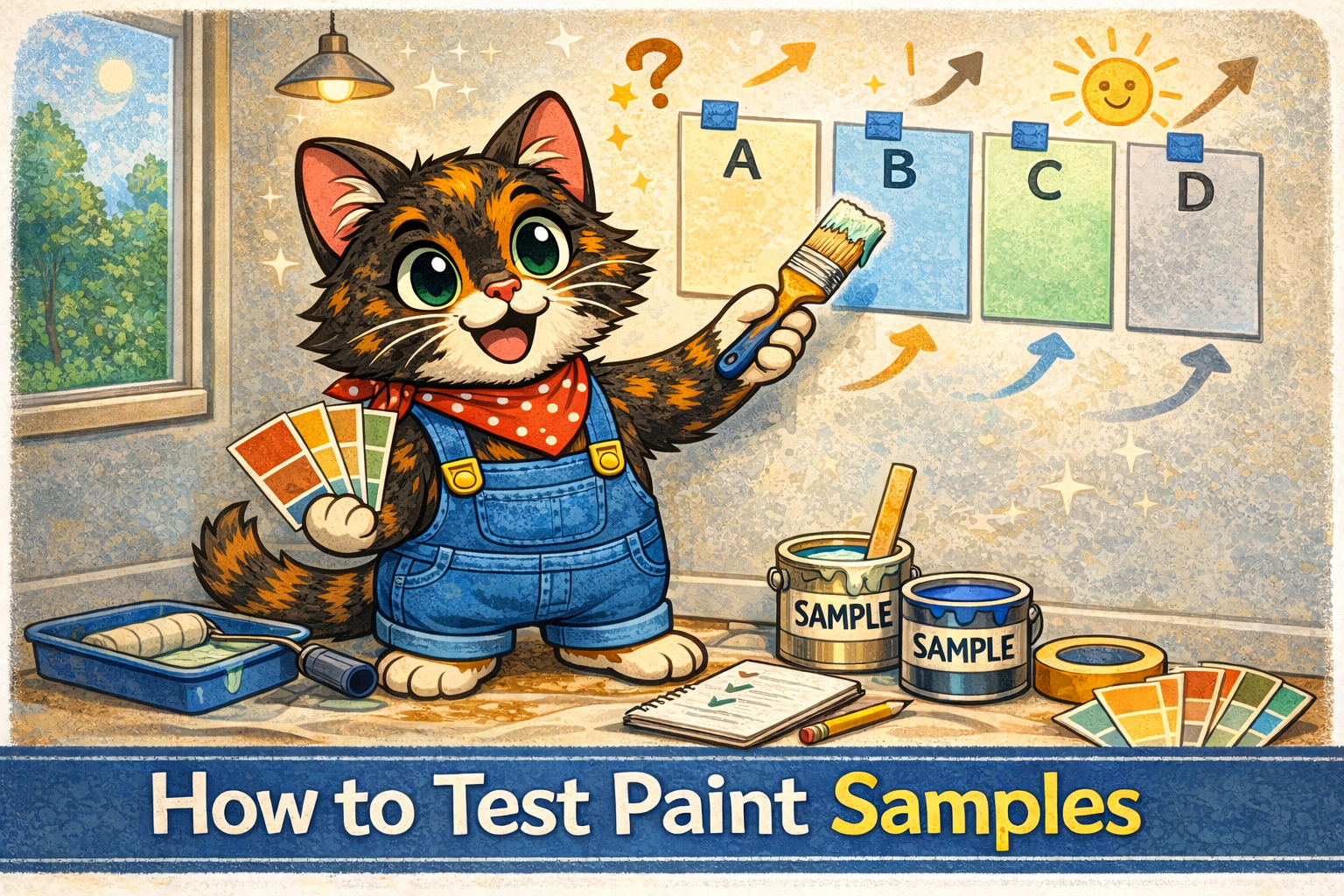
Let’s be honest.
Most of us don’t test paint samples correctly.
We:
- Slap a tiny square on the wall
- Glance at it once
- Say “looks good!”
- And commit to a gallon
And then three walls later we’re standing there thinking…
“Why does this look completely different?”
Testing paint samples the right way is the difference between loving your color and repainting an entire room.
So let’s walk through this together — beginner style, no overthinking required.
Why Testing Paint Samples Actually Matters
Paint color changes based on:
- Lighting (natural + artificial)
- Time of day
- Wall texture
- Flooring
- Furniture
- Adjacent rooms
That tiny chip in the store?
That was under fluorescent lighting, surrounded by 200 other colors.
Your house is a completely different environment.
Testing samples isn’t optional if you want confidence.
Step 1: Narrow It Down First (Don’t Buy 12 Samples)
Before you buy samples:
- Choose 2–4 strong contenders.
- Make sure they’re in the same color family.
- Compare undertones side-by-side.
If one looks slightly warmer and one slightly cooler, that’s good. That’s intentional comparison.
Buying too many samples makes everything muddy and overwhelming.
Step 2: Paint a Large Enough Area
This is where most beginners go wrong.
A 3-inch square is not enough.
Paint at least:
12″ x 12″ — or even bigger if you can.
Color behaves differently when it has space.
Small patches can look lighter or less intense than the full wall will.
Step 3: Don’t Just Paint One Spot
This is a big one.
Paint samples on:
- Different walls
- Different lighting exposures
- At least one wall with direct light
- At least one wall in shadow
Why?
Because color shifts depending on light direction.
A color can look:
- Soft and warm in sunlight
- Cold and gray in shadow
You want to see both.
Step 4: Let It Fully Dry
Wet paint lies to you.
It often looks:
- Darker
- Shinier
- More intense
Wait until it’s fully dry before judging.
Even better? Look at it the next day.
Step 5: Look at It at Different Times of Day
This is where the magic (or panic) happens.
Check your sample:
- Morning
- Midday
- Evening
- With lamps on
Some colors change dramatically.
This is especially true for:
- Grays
- Greens
- Beiges
- Blues
Step 6: Compare Samples Side-by-Side
Don’t evaluate colors one at a time.
Put your samples next to each other.
Suddenly you’ll notice:
- One looks more yellow.
- One looks more blue.
- One feels heavier.
- One feels lighter.
Comparison makes undertones obvious.
Step 7: Don’t Judge Against White Primer
If you just primed the wall, keep in mind:
Bright white primer can make colors look:
- Darker
- More intense
- More saturated
It won’t look exactly the same once the whole room is painted.
That’s normal.
Step 8: Step Back
Seriously.
Stand across the room.
Walk into the room casually.
Look at it from doorways.
You won’t experience the finished room from two feet away — so don’t judge it that way.
Optional (But Very Smart): Paint Poster Boards Instead
If you don’t want sample patches all over your wall:
- Paint large pieces of poster board.
- Move them around the room.
- Tape them up temporarily.
This lets you see the color:
- Next to furniture
- Near floors
- Under different lighting
Without committing to wall patches everywhere.
Common Beginner Mistakes When Testing Samples
Let’s call them out gently:
- Testing only one color.
- Testing only one small patch.
- Judging while paint is wet.
- Looking at it once and deciding.
- Testing only in daylight.
- Ignoring undertones.
None of these mean you’re bad at picking colors.
They just mean you’re learning.
How to Know You’ve Found “The One”
It’s usually not dramatic.
It’s more like:
- You stop noticing it in a bad way.
- It feels balanced in most lighting.
- It doesn’t clash with flooring.
- It feels calm when you walk in.
If you keep second-guessing a color, that’s information.
Trust that feeling.
The Encouraging Truth
Testing paint samples isn’t about being indecisive.
It’s about being strategic.
The few extra days you spend testing can save:
- Time
- Money
- Repainting
- Frustration
And once you’ve tested colors properly once, you’ll never skip it again.
Leave a Reply