
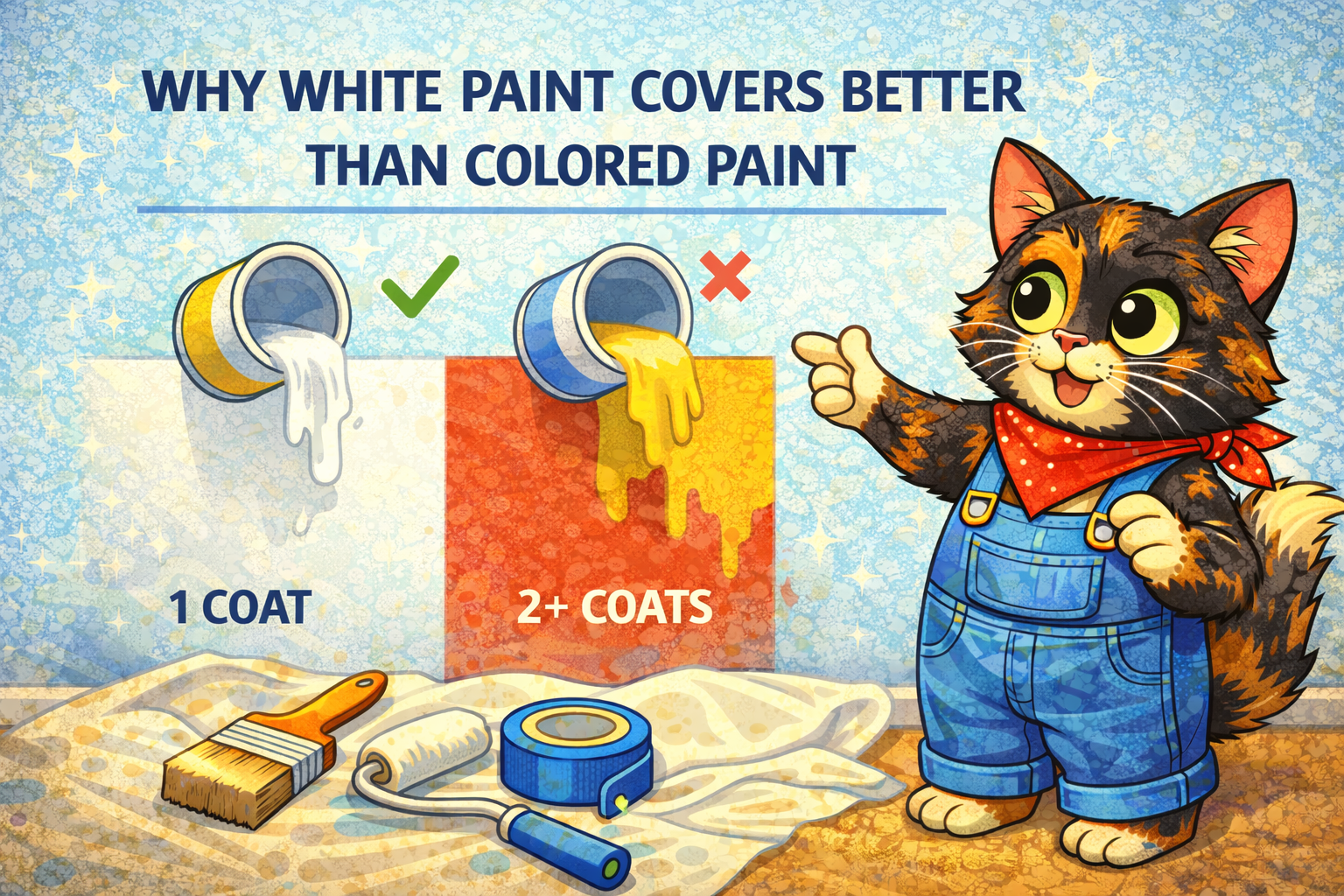
If you’ve ever painted a wall white and thought, “Wow, that was easy,” then tried a bold color and thought, “Why can I still see the old color through this?!”
You’re not imagining things.
White paint really does tend to cover better than most colored paints — and there are a few simple reasons why.
Let’s walk through it together.
It All Starts With Pigment
Remember how paint is made up of pigment, binder, solvent, and additives?
Pigment is what gives paint its color.
White paint uses a special pigment called titanium dioxide (sounds fancy, but it’s just a super powerful white pigment).
This pigment is amazing at:
✔ Blocking what’s underneath
✔ Reflecting light
✔ Creating a solid, opaque layer
In simple terms — it hides stuff really well.
White Pigment Is Extra Strong
Titanium dioxide is one of the most effective covering pigments out there.
That’s why:
- White paint often needs fewer coats
- White primer covers dark colors easily
- White paint looks solid faster
Most colored paints use different pigments that aren’t quite as good at blocking old colors underneath.
Dark and Bright Colors Are Often More Transparent
This part surprises a lot of beginners.
Even though dark colors look bold, many of them are actually more see-through than white.
Colors like red, yellow, blue, and green often need more coats because their pigments don’t block light as well.
That’s why painting over a dark wall with bright red can take several coats, while white might cover faster.
White Paint Reflects Light (Which Helps It Look Solid)
White paint reflects a lot of light.
That reflection makes it appear:
- Brighter
- Fuller
- More even
Colored paint absorbs more light, which can make thin spots easier to see.
So even when colored paint is applied evenly, it may look less solid until extra coats are added.
This Is Also Why Primer Is Usually White (or Light)
Ever notice most primer is white or light gray?
That’s not random.
Primer uses pigments that block old colors really well — similar to white paint.
Using primer before bold colors helps:
- Improve coverage
- Reduce number of coats needed
- Make colors look truer
It’s basically giving your paint a clean, easy-to-cover base.
Does This Mean White Paint Is “Better”?
Not better — just better at covering.
Colored paints can be just as durable and high-quality.
They just often need:
- More coats
- A primer underneath
- A little more patience
And that’s totally normal.
A Simple Way to Remember It
White paint = super strong hiding pigment
Colored paint = pigments that are more transparent
So white usually covers faster and easier.
Final Thoughts
If white paint feels easier to work with, now you know why.
It’s not because you suddenly became a painting pro — it’s because white pigment is incredibly good at blocking what’s underneath.
When working with bold or dark colors, using primer and planning for extra coats can make a huge difference.
Painting gets way less frustrating once you understand these little science-y secrets behind the scenes.
Leave a Reply