
Let’s talk about one of the biggest beginner surprises in painting:
You pick “white.”
You paint it on the wall.
And suddenly it looks… yellow.
Or blue.
Or gray.
Maybe even pink.
And you’re thinking:
“This was supposed to be WHITE.”
Here’s the truth no one tells beginners clearly enough:
There is no such thing as “just white.”
White paint has undertones — and those undertones completely change how it feels in your space.
Let’s break this down in a simple, learning-alongside way so you can finally understand why one white feels cozy and another feels crisp.
First: What Is an Undertone?
Think of paint color in two layers:
- The main color (what you see first)
- The undertone (the subtle color hiding underneath)
With white paint, the main color looks neutral.
But the undertone is what makes it:
- Warm
- Cool
- Creamy
- Bright
- Soft
- Stark
And because white is so light, undertones are actually more noticeable, not less.
Warm White = Cozy, Soft, Inviting
Warm whites have undertones like:
- Yellow
- Cream
- Beige
- Sometimes a hint of red or peach
These whites feel:
- Cozy
- Relaxed
- Comfortable
- Slightly creamy
They pair beautifully with:
- Warm wood floors
- Beige or tan furniture
- Brass or gold fixtures
- Traditional or farmhouse styles
In north-facing rooms (which get cooler light), warm whites can balance things out and prevent the room from feeling icy.
But here’s the catch:
In a room with lots of warm sunlight, a warm white can start to look very yellow.
Cool White = Crisp, Clean, Modern
Cool whites have undertones like:
- Blue
- Gray
- Sometimes green
These whites feel:
- Fresh
- Bright
- Airy
- Clean
They work well with:
- Gray flooring
- Black fixtures
- Modern decor
- South-facing rooms (which get warm sunlight)
Cool whites prevent spaces from feeling overly yellow.
But in a north-facing room?
They can feel cold or slightly sterile.
Why White Paint Changes So Much in Your Home
Lighting is everything.
White paint acts like a mirror for light.
That means it reflects:
- Natural daylight
- Artificial lighting
- Floor color
- Cabinet color
- Even nearby walls
So a white that looked perfectly neutral in the store might:
- Look yellow in your living room
- Look blue in your hallway
- Look gray in your bedroom at night
That’s not you imagining it.
That’s undertones reacting to the environment.
The “Why Does This White Look Yellow?” Moment
This is one of the most common beginner frustrations.
Usually what’s happening:
- You chose a warm white.
- Your room has warm lighting.
- Your floors are warm-toned.
- The sun hits that wall directly.
All that warmth adds up.
Suddenly your “soft white” looks buttery.
The opposite can also happen:
- You choose a cool white.
- Your room has gray flooring.
- It’s a north-facing space.
Now it feels slightly icy or gray.
How to Tell If a White Is Warm or Cool
Here’s a simple trick:
Hold the white paint sample next to a bright, clean white piece of paper.
If it looks slightly:
- Creamy or yellow → it’s warm.
- Blue, gray, or icy → it’s cool.
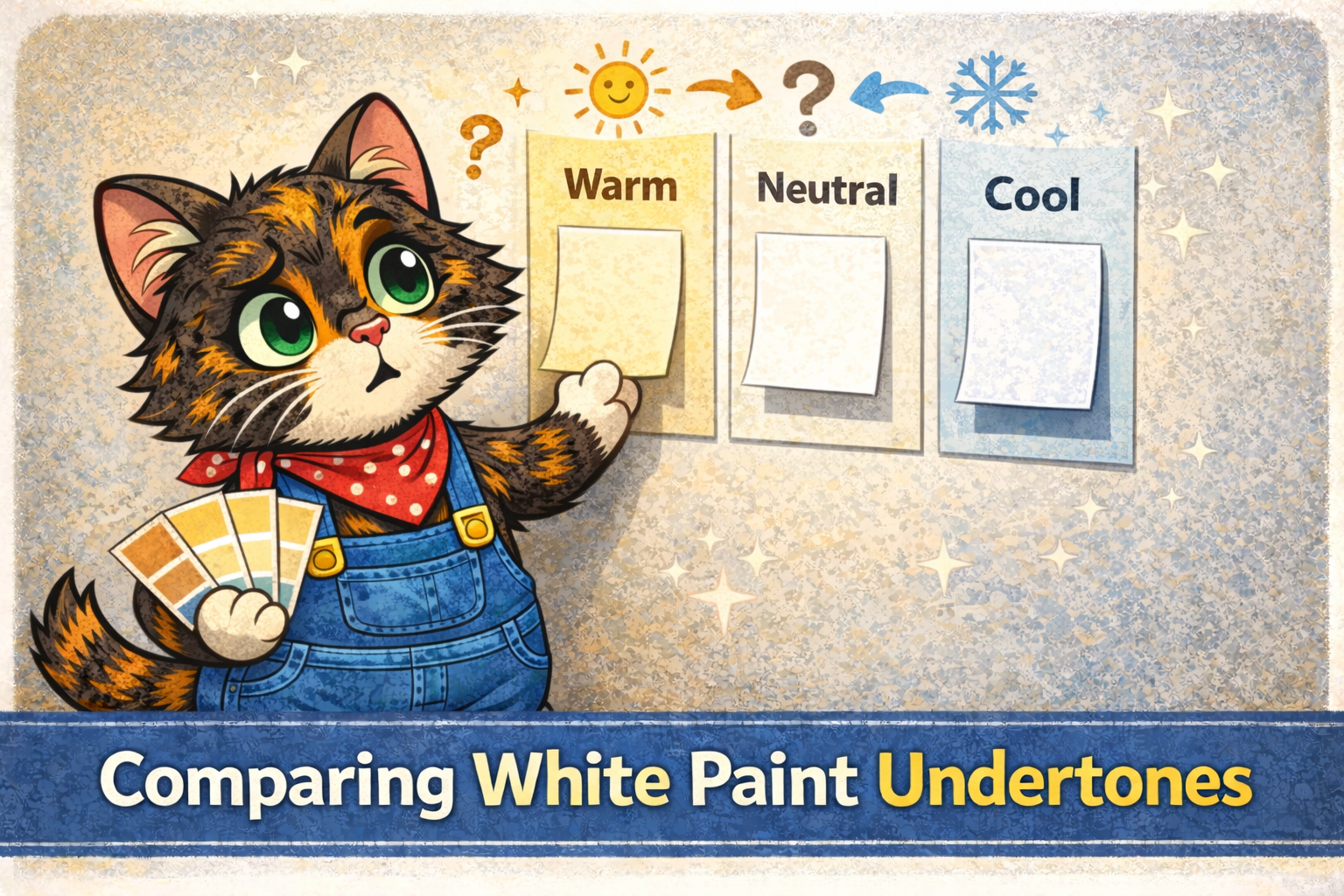
Comparing whites side-by-side also helps. When they’re alone, they all look white. Next to each other, undertones show up immediately.
Why Some Whites Feel “Cozy” and Others Feel “Crisp”
It’s not just color — it’s mood.
Warm whites:
- Absorb a little warmth
- Soften the space
- Feel lived-in
Cool whites:
- Reflect more light
- Feel sharp and clean
- Emphasize brightness
Neither is better.
They just create different energy.
The Biggest Beginner Mistake With White Paint
Assuming white is neutral enough to skip testing.
White is actually one of the most important colors to test.
Because once it’s covering every wall?
Those undertones become very obvious.
Always test white samples:
- On multiple walls
- In different lighting
- Next to flooring and cabinets
- During morning and evening
White changes more than you expect.
So Which White Should You Choose?
Here’s a simple starting point:
Choose warm white if:
- Your floors are warm wood
- You want cozy and inviting
- Your room faces north
Choose cool white if:
- Your floors are gray or dark
- You want modern and crisp
- Your room gets lots of warm sunlight
When in doubt?
Test one warm and one cool option side-by-side.
The right one will feel balanced — not too yellow, not too icy.
The Encouraging Truth
If you’ve ever painted a room white and thought:
“Why does this look off?”
You’re not bad at picking colors.
You just hadn’t met undertones yet.
Once you understand how white undertones work, choosing between cozy and crisp becomes intentional instead of stressful.
And that’s when painting starts to feel empowering instead of confusing.
White Undertone Comparison Chart
| Feature | Warm White | Neutral White | Cool White |
|---|---|---|---|
| Common Undertones | Yellow, cream, beige, soft red | Very subtle warmth or gray | Blue, gray, slight green |
| How It Feels | Cozy, soft, inviting | Balanced, flexible | Crisp, clean, modern |
| Best For | Bedrooms, living rooms, traditional spaces | Open floor plans, mixed decor | Bathrooms, modern kitchens, bright spaces |
| Works Well With | Warm wood floors, brass, beige furniture | Mixed warm & cool elements | Gray floors, chrome, black accents |
| In North-Facing Rooms | Balances cool light nicely | Safe option | Can feel cold or icy |
| In South-Facing Rooms | May look more yellow | Stays fairly balanced | Offsets warm sunlight |
| Common Beginner Reaction | “Why does this look yellow?” | “This feels safe.” | “Why does this look blue/gray?” |
| Lighting Sensitivity | Looks warmer in warm light | Moderately stable | Looks cooler in shadow |
Quick Decision Guide
If your room feels:
- Too cool → try a warm white
- Too warm → try a cool white
- Balanced but tricky → try a neutral white
Simple Testing Tip
Always test:
- One warm white
- One cool white
- One neutral white
Side-by-side.
Undertones are much easier to see when compared directly.
Leave a Reply