
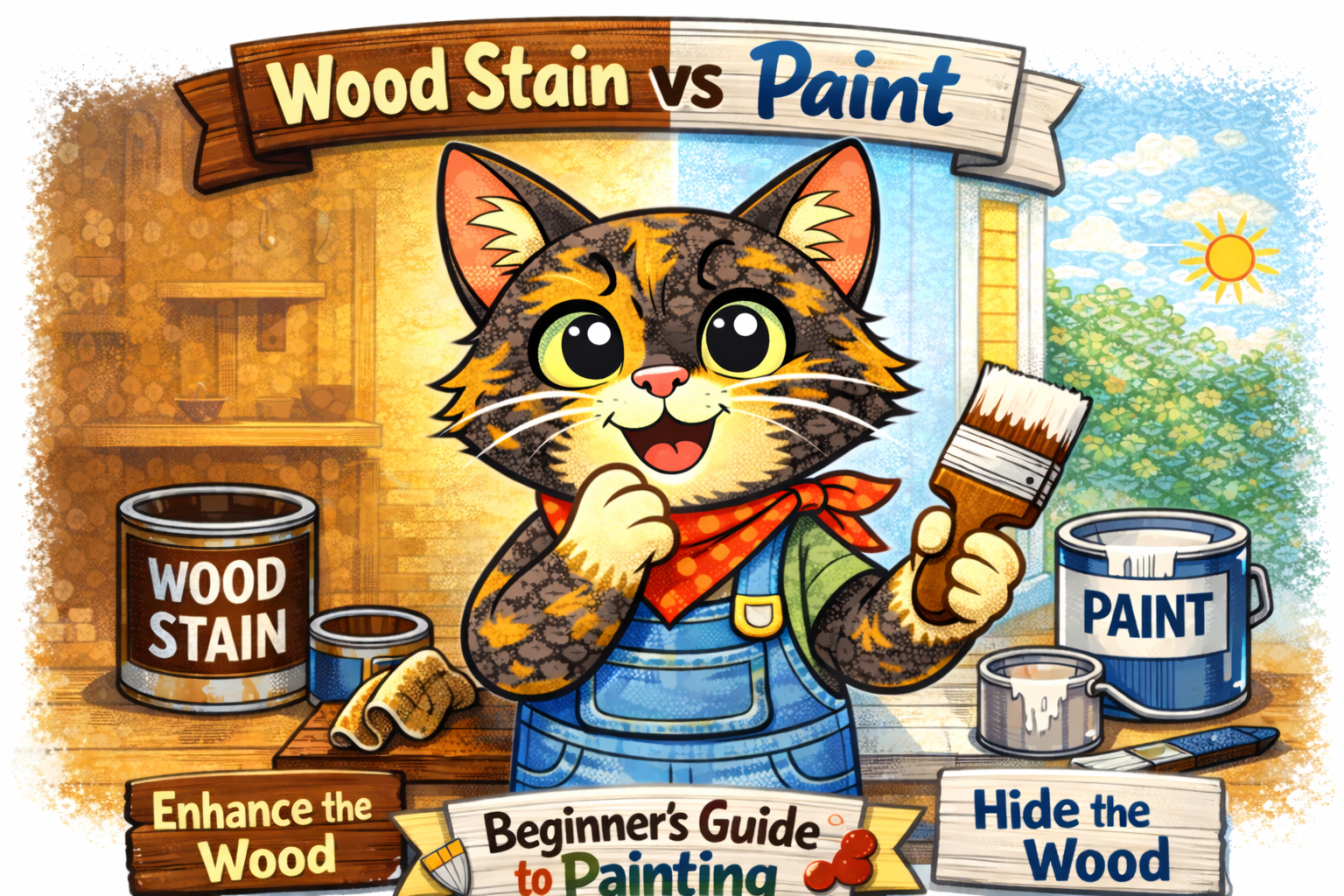
If you’re brand new to DIY projects, wood stain and paint can look like they do the same thing: change the color of wood.
But they actually work in completely different ways — and choosing the wrong one can totally change the outcome of your project.
Let’s break this down in simple, beginner-friendly terms.
What Is Wood Stain?
Wood stain is a coloring product that soaks into the wood instead of sitting on top of it.
It’s designed to:
- Add color
- Enhance the natural wood grain
- Bring out texture and character
- Deepen or warm up the tone of the wood
Unlike paint, stain doesn’t create a thick outer layer. It penetrates the surface and tints the fibers.
Think of it like:
- Lotion soaking into skin
instead of - A layer of makeup sitting on top
You still see the wood. You just see a colored version of it.
What Is Paint?
Paint works very differently.
Paint:
- Sits on top of the surface
- Forms a solid film
- Completely covers the wood grain
- Creates an opaque finish
When you paint wood, you’re essentially hiding what’s underneath.
You can make wood look:
- Bright white
- Deep navy
- Matte black
- Soft sage green
The natural wood pattern disappears under that coating.
The Core Difference (In Plain English)
Here’s the simplest way to think about it:
| Wood Stain | Paint |
|---|---|
| Soaks into wood | Sits on top |
| Shows wood grain | Covers wood grain |
| Transparent or semi-transparent | Opaque |
| Enhances natural look | Changes the look entirely |
| Usually needs a protective topcoat | Often acts as color + protection |
When Would You Choose Wood Stain?
Wood stain is usually best when:
- You like the look of the wood grain
- You’re working with beautiful hardwood (like oak, walnut, maple)
- You want a natural, warm finish
- You’re refinishing furniture
- You’re staining decks, fences, or cabinets
Stain is common in:
- Rustic styles
- Farmhouse design
- Traditional interiors
- Outdoor wood projects
When Would You Choose Paint?
Paint is usually better when:
- The wood isn’t attractive (knots, patchy grain, filler spots)
- You want a bold color
- You’re covering imperfections
- You want a clean, modern look
- You need heavier surface protection
Paint works great for:
- Trim
- Cabinets
- Built-ins
- Furniture makeovers
- Accent pieces
A Beginner Mistake to Avoid
One thing that surprises beginners:
You cannot stain over paint.
Stain needs bare wood to soak into. If paint is already there, it blocks absorption.
However…
You can paint over stained wood (with proper prep like sanding and priming).
Does Wood Stain Protect Wood?
Not by itself.
Most stains:
- Add color
- May offer minimal water resistance
- But do NOT fully protect against wear and damage
That’s why stained wood usually needs:
- Polyurethane
- A clear sealer
- Or another protective topcoat
Paint, on the other hand, creates a protective surface film as it dries.
What About Gel Stain?
Quick beginner note:
Gel stain is thicker and sits closer to the surface than traditional stain. It’s often easier for beginners because:
- It drips less
- It’s easier to control
- It can sometimes go over lightly finished surfaces
But it still works differently than paint — it’s meant to enhance, not fully cover.
So… Which One Should You Use?
Ask yourself:
- Do I want to see the wood grain?
- Is the wood itself attractive?
- Am I going for natural or bold?
- Am I covering damage or highlighting character?
If you want:
- Natural beauty → Stain
- Full transformation → Paint
Neither is “better.” They just serve different purposes.
Final Beginner Takeaway
Wood stain and paint are not interchangeable.
- Stain enhances.
- Paint covers.
If you love the personality of wood, stain is your friend.
If you want a dramatic color shift, paint is the way to go.
And the best part? As a beginner, you don’t have to get it perfect. Every project teaches you something — and that’s the real win.
FAQ
Quick answers to the most common beginner questions.
Not really — they do different things. Wood stain soaks into the wood and enhances the grain, while paint sits on top and completely covers it. If you’re trying to get a solid, opaque color (like white cabinets or a black dresser), stain won’t give you that look. But if you love seeing the wood’s natural character, stain might be perfect.
Yes — you can paint over stained wood. You’ll just need to prep it properly first by cleaning, lightly sanding, and usually applying a primer. Paint sticks best to a slightly rough surface, so that prep step really matters.
No — stain needs bare wood to absorb into. Paint blocks the pores of the wood, so stain won’t soak in. If you want to stain something that’s already painted, you would have to completely strip or sand off the paint first.
It depends on the project and whether you seal it. Interior stain that’s properly sealed with polyurethane can last many years. Exterior stain (like on decks or fences) usually needs maintenance every few years. Paint also lasts a long time, but it can chip or peel if the surface wasn’t prepped well.
For beginners, it can go either way. Stain can be easier because it doesn’t show brush strokes the same way paint does — but it can also be blotchy if applied unevenly. Paint gives you more forgiveness in color coverage, but you have to watch for drips and roller marks. Neither is “hard” — they just require slightly different techniques.
Yes, most of the time. Stain adds color, but it doesn’t fully protect the surface. If the project will get touched, cleaned, or exposed to moisture, you’ll want to apply a clear topcoat like polyurethane to protect it.
It depends on the look you want. If the wood is high quality and has beautiful grain, stain can highlight it. If the wood is scratched, mismatched, or made from cheaper materials, paint can give it a fresh, clean makeover. There isn’t a “right” answer — just the right choice for your goal.
Leave a Reply